
Table of Contents
Key Takeaways
Point Details
Prioritize evidence-based sources Only trust supplement rankings that explain their scientific criteria and use up-to-date findings.
Master risk assessment Scorecards with clear safety criteria dramatically reduce the risk of supplement misuse.
Evaluate before you buy Always use ranking tools and cross-check information to ensure you’re making the best choice.
Avoid common mistakes Don’t rely on marketing hype or unreviewed lists; focus on proven research and transparent rankings.
Understanding supplement rankings: What matters most
Supplement rankings are structured evaluations that score products based on defined criteria, typically safety, ingredient quality, clinical evidence, and user outcomes. Think of them as a report card for a product, except the grading system matters as much as the grade itself.
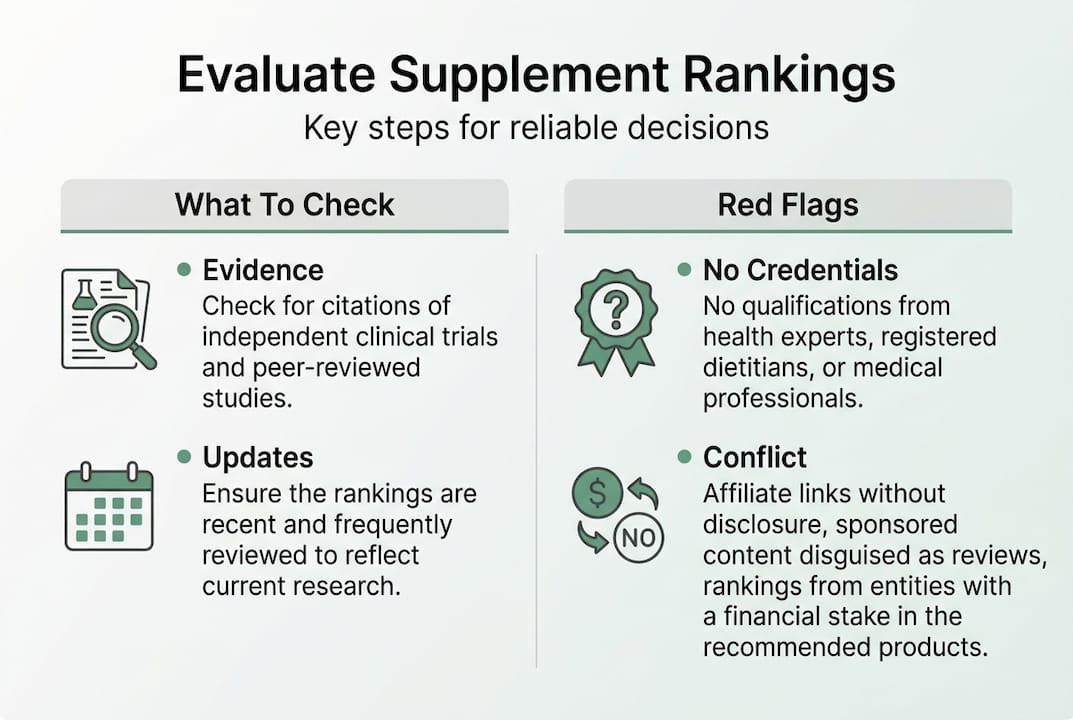
Not all ranking systems are built the same. Some are funded by brands with a financial stake in the outcome. Others rely on user reviews alone, which can be gamed. Trustworthy rankings use transparent, science-backed criteria that any reader can verify. Here’s what the best systems typically evaluate:
-
Safety profile: Are the ingredients tested for contaminants and interactions?
-
Clinical evidence: Do peer-reviewed studies support the core ingredients?
-
Ingredient quality and supplement purity: Are doses effective and sourced responsibly?
-
Label transparency: Does the product disclose all ingredients and amounts?
-
Third-party testing: Has an independent lab verified the product’s contents?
A risk scorecard can classify the safety of dietary supplements with 86% accuracy after user education. That’s a significant number. It means that when consumers are equipped with the right tools, they can make genuinely informed calls about risk, not just guess based on packaging.
“The best ranking systems don’t just tell you what’s popular. They tell you what’s proven and what’s potentially dangerous.”
Pro Tip: Before trusting any ranking site, scroll to their methodology page. If they don’t have one, that’s your first red flag.
Rankings serve a dual purpose: they reduce the cognitive load of comparison shopping while also protecting you from products that look credible but aren’t. A well-built ranking system is a filter, not just a list.
Essential tools for ranking supplements: What you need
Understanding the factors in rankings is just the start. Here’s what you need to do accurate comparisons.
You don’t need a science degree to evaluate supplement rankings effectively. You do need the right set of resources and a basic understanding of how to use them together.
Core resources every consumer should use:
-
Ingredient labels: The foundation of any evaluation. Learn to read serving sizes, proprietary blends, and fillers.
-
Ranking databases: Platforms like RankOfSupplements.com aggregate expert reviews with consistent criteria.
-
PubMed or Google Scholar: Free access to peer-reviewed research on specific ingredients.
-
FDA adverse event reports: The FDA’s CFSAN database logs reported supplement-related health incidents.
-
Third-party certification databases: NSF International and USP verify label accuracy and purity.
One of the most practical tools available is the Operation Supplement Safety scorecard, which uses 7 key criteria for risk assessment. It evaluates factors like whether the product is FDA-regulated, whether it contains stimulants, and whether it’s marketed for a high-risk use case like rapid weight loss.
Tool What it evaluates Best used for
Operation Supplement Safety Risk level, ingredient flags Safety screening
NSF/USP certification Label accuracy, purity Quality verification
PubMed Clinical ingredient evidence Effectiveness research
Ranking platforms Overall product scoring Goal-based selection
Cross-checking sources is non-negotiable. A product can look great on one platform and terrible on another. When that happens, dig into why. Often, the discrepancy reveals either a conflict of interest or outdated data.
For fitness-focused goals, understanding how supplements work together is just as important as individual rankings. Learning about synergy for best results can help you stack products intelligently rather than randomly.
Red flags to watch for on ranking sites include: no author credentials listed, affiliate links without disclosure, rankings that never change, and no mention of safety criteria alongside effectiveness scores.

Step-by-step: How to evaluate a supplement using rankings
With the right resources in hand, let’s put them to use and walk through the process, step by step.
Here’s a practical, repeatable process you can apply to any supplement before buying:
-
Identify a reputable ranking source. Start with platforms that publish their methodology and update regularly. Look for editorial independence.
-
Pull up the product’s full ranking profile. Note the overall score and check whether it breaks down safety, effectiveness, and quality separately.
-
Run the product through a risk scorecard. Scorecards help users correctly classify supplements by risk, so don’t skip this step even if the product looks clean.
-
Compare against a benchmark product. Use a well-reviewed product in the same category as your baseline.
-
Read reviewer notes, not just scores. Scores summarize, but notes explain. Look for mentions of side effects, dosing issues, or ingredient substitutions.
-
Match the product to your specific goal. A supplement ranked highly for endurance may not be optimal for hypertrophy.
Factor Bulk Extreme Mass Extreme
Primary goal Muscle mass and recovery Rapid mass and strength
Key ingredients Maca, fenugreek, nettle Pea protein, beta-alanine
Safety profile Well-documented Well-documented
Third-party testing Yes Yes
Pro Tip: Always check the date of the last review update. Supplement formulas change, and a ranking from two years ago may not reflect the current product.
This process takes about 15 minutes per product. That’s a small investment compared to spending money on something that doesn’t work or, worse, causes harm.
Common mistakes and how to avoid them
Knowing the steps is great, but avoiding these common traps will help you get the most out of supplement rankings.
Even well-intentioned consumers fall into predictable patterns that undermine their decision-making. Here are the most common ones:
-
Treating rankings as absolute truth. Rankings are tools, not verdicts. They reflect the data available at the time of review.
-
Ignoring safety in favor of effectiveness scores. A supplement that works fast but carries serious risk isn’t a good deal.
-
Relying on a single source. One platform’s top pick may be another’s cautionary tale. Always cross-reference.
-
Skipping the label check. Marketing copy and actual ingredients don’t always match. Why purity matters becomes very clear when you find undisclosed additives.
-
Ignoring condition-specific rankings. If you’re looking for varicose veins support, a general wellness ranking won’t give you the specificity you need.
“Education doesn’t just improve your choices. It changes what you notice.”
Scorecard education improved risk recognition for dietary supplements significantly in consumer studies. That means the more you practice using structured evaluation tools, the faster and more accurately you can spot problems.
Another underrated mistake is confusing popularity with quality. A supplement trending on social media may have zero peer-reviewed backing. Viral doesn’t mean validated. When you see a product dominating influencer feeds, that’s actually a signal to apply more scrutiny, not less.
Finally, watch for ranking sites that only review products they sell. Conflict of interest is the single biggest threat to ranking credibility.
What results should you expect?
Armed with your new ranking savvy, here’s what you can expect as you put your choices into practice.
Using supplement rankings correctly doesn’t guarantee overnight transformation. What it does guarantee is a smarter starting point. Here’s what shifts when you apply this process consistently:
-
Fewer wasted purchases. You stop buying products based on hype and start buying based on evidence.
-
Better goal alignment. Rankings help you match products to your actual objectives, whether that’s fat loss, muscle gain, or immune support.
-
Reduced safety risk. Educated consumers classify supplement safety accurately after using evidence-based scorecards, which means fewer adverse reactions and better outcomes.
-
Increased confidence. You stop second-guessing every purchase because you have a repeatable system.
-
Longer-term health thinking. Rankings push you to consider cumulative effects, not just short-term results.
Track your outcomes. Keep a simple log of what you’re taking, when you started, and what changes you notice after four to eight weeks. If a highly-ranked supplement isn’t delivering results for you personally, that’s valid data. Individual biology varies, and rankings reflect population-level evidence, not individual guarantees.
Revisit rankings every few months. New research emerges, formulas change, and your goals may shift. A ranking that was right for your cutting phase may not be right for your bulking phase. Treat this as an ongoing practice, not a one-time decision.
Why evidence-based supplement rankings will always matter
Here’s an uncomfortable truth most ranking sites won’t tell you: the number one supplement on any list is only as good as the criteria used to rank it. Chasing “the best” without understanding the methodology behind the score is just a more sophisticated version of trusting a flashy label.
Supplement science moves fast. Ingredients that looked promising five years ago have since been debunked. Others that were overlooked have strong new evidence behind them. Rankings that don’t evolve with the research become misleading, even when they started honest.
Transparency is everything. When a ranking platform shows you exactly how they score products, including how they weight safety versus effectiveness, you can decide whether their priorities match yours. That’s real empowerment. Purity always counts in any credible ranking system, and platforms that bury or ignore it should be treated with skepticism.
The best rankings don’t just rate. They teach you how to think about supplements. That skill compounds over time and makes every future choice easier and safer.
Discover top supplement rankings you can trust
Ready to put your new knowledge into practice? Here’s where to start.
At RankOfSupplements.com, every review is built on transparent criteria, updated regularly, and written without brand sponsorship influence. Whether you’re evaluating a fat burner like Fat Burn Active, a performance product like Nutrigo Lab Strength, or exploring options for immune support, you’ll find rankings that prioritize safety and science over sales.
Our goal is simple: give you the information you need to make confident, evidence-based decisions. Browse rankings by health goal, read full ingredient breakdowns, and compare products side by side. Your next supplement choice doesn’t have to be a guess.
Frequently asked questions
What is the most important factor in supplement rankings?
Safety and scientific evidence are the most critical criteria in any trustworthy ranking system. The Operation Supplement Safety scorecard uses 7 key criteria for risk assessment, making safety evaluation structured and repeatable.
How can I tell if a ranking site is trustworthy?
Look for transparent evaluation criteria and verify that rankings are backed by scientific research or scorecard methods. Sites that correctly classify supplements by risk using defined tools are far more reliable than those relying on user votes alone.
Are supplement rankings different for weight loss, muscle gain, or wellness?
Yes, rankings consider different criteria based on your health goal, but safety and quality always come first. The Operation Supplement Safety scorecard applies both general and condition-specific criteria to account for these differences.
Can supplement rankings guarantee results?
No. Rankings guide your choices based on population-level evidence, but individual responses and consistency with use matter most for real outcomes.
How often are supplement rankings updated?
Responsible ranking platforms update their ratings whenever new research emerges or significant product formulation changes occur, so always check the review date before relying on a score.